Over the past week, the weather has remained extremely hot. The Hong Kong Observatory (HKO) issued the Very Hot Weather Warning for several consecutive days and forecast that, under the influence of the El Niño phenomenon, this year’s average temperature will likely be higher than normal. Hot weather is also closely linked to the Air Quality Health Index (AQHI). In the future, the public’s health may be affected by both high temperatures and air quality at the same time.
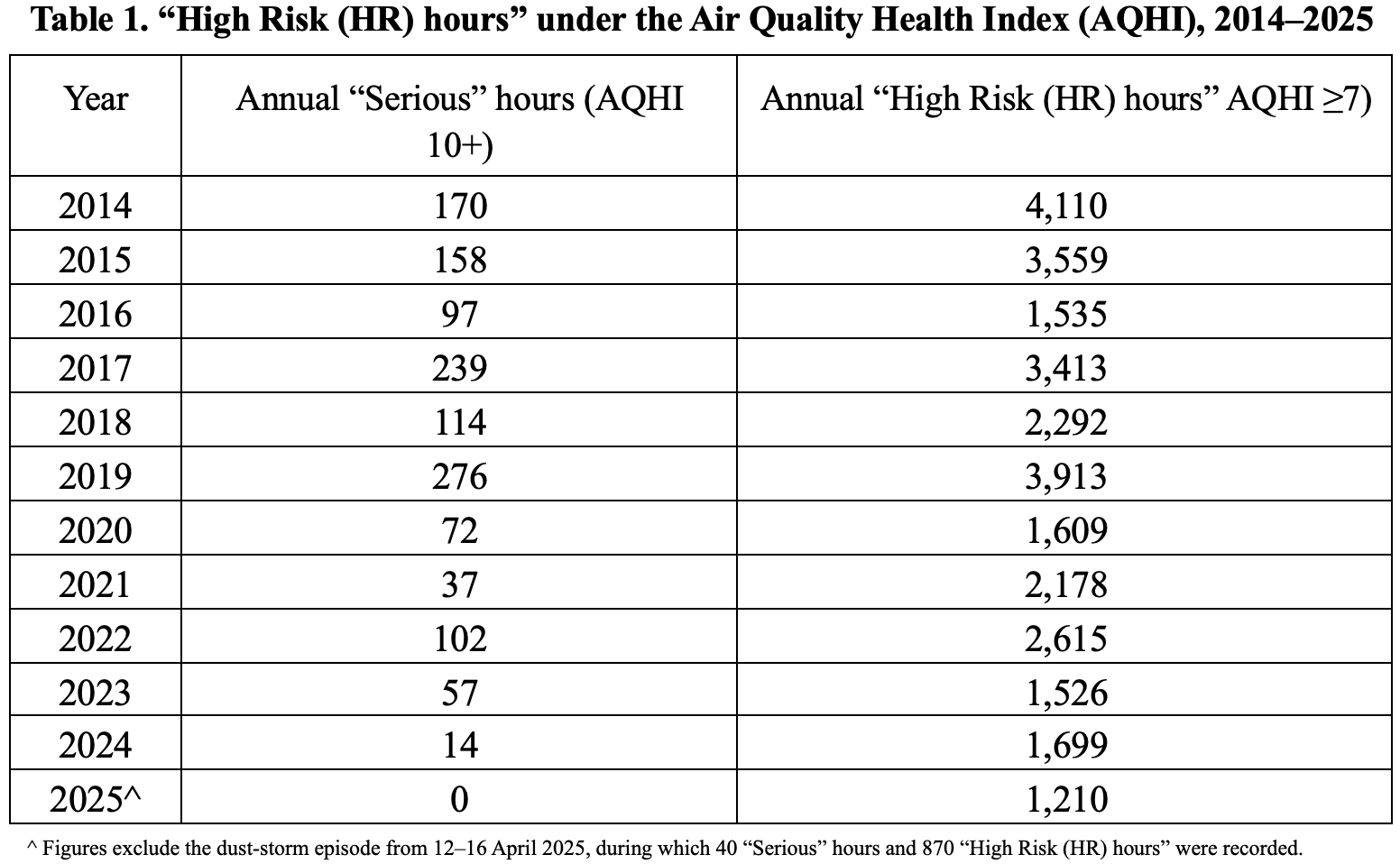
Launched in 2014, the Air Quality Health Index (AQHI) aims to help the public understand the health risks associated with air quality. An index of 7 indicates “High” health risk; 8–10 indicates “Very High”; and 10+ indicates “Serious”, for which the public should take appropriate precautionary measures. Green Power reviewed last year’s (2025) AQHI records and summarised the citywide air quality situation. It found that the 15 General Stations recorded a total of 2,080 hours at High, Very High and Serious levels—collectively referred to as “High Risk (HR) hours”.
Dr Cheng Luk-ki, Director of Green Power, said that Hong Kong was affected by a rare dust storm from northern China last April which pushed up the annual total of “High Risk” hours. In just five days, the AQHI recorded 40 hours at the “Serious” level. However, as dust storms are rare events, it is more appropriate to exclude the dust-storm period when comparing AQHI trends over the past decade. After excluding the relevant figures, 2025 recorded only 1,210 High Risk (HR) hours, the lowest since the AQHI system commenced, while the number of “Serious” hours was zero—leading to 2025 the best AQHI record in more than a decade (Table 1).
Dr Cheng noted that in recent years Hong Kong’s local air quality has continued to improve, as the fuel mix for local power generation has progressively shifted away from coal with a higher share of natural gas; the Government has tightened emission standards for fuel-powered vehicles; electric vehicles have become increasingly popular; and ongoing regional collaboration has also contributed to better air quality.
Air quality is closely linked to hot weather
Dr Cheng said previous research by a local university found that for every 1°C increase when the daily mean temperature exceeds 29°C, local hospital admissions increase by 4.5%, part of which is attributable to air quality. He conducted a detailed analysis of last summer’s (June to September) AQHI data and found nine days when the index reached the “High” risk level. On all of those days, the daily mean temperature exceeded 29°C, and the HKO also issued the Very Hot Weather Warning—demonstrating a strong connection between heat and air quality.
Dr Cheng explained that high temperatures favour the formation of ozone in the lower atmosphere. Ozone has long been a major contributor to the health risks associated with local air pollution. He warned that, under climate change, hot weather is likely to become more frequent. The Government should therefore strengthen regulation of ozone precursors, including the use of substances such as volatile organic compounds (VOCs), in order to further improve air quality.
In addition, the five districts with the highest number of “High Risk” hours last year were, in descending order: Tuen Mun, Tai Po, Northern District, Yuen Long and Tung Chung. These districts were also among the hotter areas in Hong Kong in 2025, suggesting that residents there are more vulnerable to health risks from air pollution under high temperatures. Green Power recommends that the Government implement more cooling measures in these districts, such as increasing greenery coverage, revitalising local rivers, and incorporating more ventilation corridor designs.