Concerning the "Least Concern" - Green Turtle


%20Peggy%20Chung.png)
Adult Green Turtles (Chelonia mydas) are huge and protected by sturdy shells. They have hardly any predators in the ocean if not for the humans on land. But their hatchlings and juveniles would have to overcome serious natural and man-made challenges growing up. After decades of decline, Green Turtles' status was finally downgraded from Endangered to Least Concern by the International Union for Conservation of Nature on its Red List of Threatened Species in 2024. The good news is not an occasion for celebration yet. Scientists emphasised that the Green Turtle is a conservation-dependent species and warned against dropping our guard. Reclassification notwithstanding, odds faced by Green Turtles before they reach adulthood persist.
The Green Turtle is the most numerous and widely distributed, extending throughout tropical and subtropical waters across the globe between 40°N and 40°S latitudes, of the Family Cheloniidae which has only six species.
The adult, notable for its smooth heart-shaped shell, can grow to 1.5-metre-long and weighs about 200 kilograms. Why the dark brown rather than green mariner is called "Green" Turtle? It acquired the name for the greenish-coloured fat stored inside. Its limbs have adapted for aquatic locomotion into strong paddle-like flippers which allow it to move effortlessly underwater but clumsily on land.
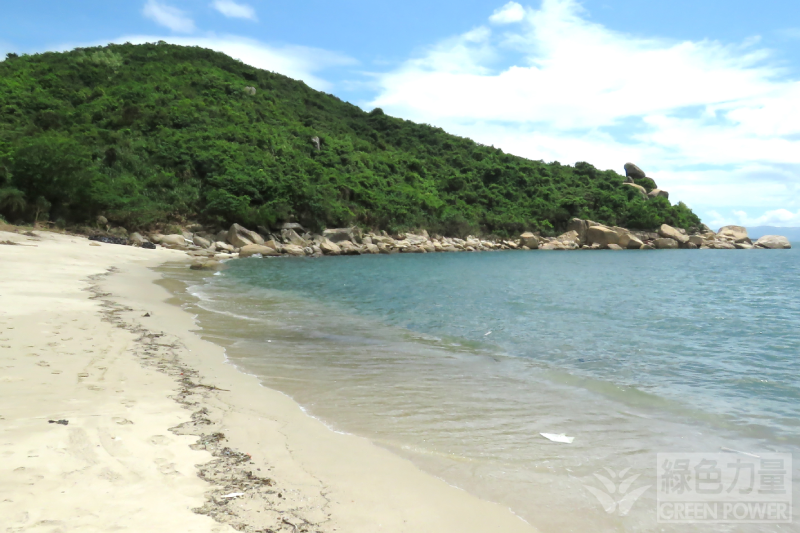
Green Turtle is the only sea turtle species known to breed in Hong Kong. During the 60s and 70s, they nested on the east coast of Hong Kong. The beach at Sham Wan on Lamma Island is the only beach they nest at present. Therefore, the Agriculture, Fisheries and Conservation Department has restricted public access to Sham Wan beach and its nearby waters during the breeding season of Green Turtles between April and October every year.
Death threats
Green Turtles can live to 80 or over 100 according to some record. But it takes tremendous efforts for a Green Turtle to reach adulthood.
Green Turtles grow extremely slow. It may take 20 to 50 years for a juvenile in the wild to reach sexual maturity. Mature Green Turtles travel from their foraging grounds to natal beaches to breed and nest. In one nesting season, a female could lay several hundreds of eggs with about one hundred a clutch when it comes ashore. If the eggs survive from predation, they will hatch between six to eight weeks. Hatchlings are preyed upon by birds, crabs and other predators on their dash to the sea. Only about half of the hatchlings make it to the water according to some study.
Upon entering the ocean, greater menaces await. Hatchlings become targets for various fish (sharks in particular) and cephalopods. The mortality rate is the greatest at this stage. Very few hatchlings survive to adulthood.
%20sue_churchill.jpg)
%20Peggy%20Chung.png)
Death by humans
Nothing imperils Green Turtles' survival both underwater and on land more than human activities. With a life constantly hanging in the balance, coastal developments are the foremost threat. Green Turtles, guided by an innate sense of navigation, return to its birthplace to breed and nest. Loss of habitat turns them away. Presence of light pollution, buildings, vehicles and tourists on the beach impacts their reproductive success.
Our plastic waste is a death trap. Plastic debris and bags in the ocean could cause gut blockages, malnutrition, food poisoning, or even choke Green Turtles to death if ingested. Discarded fishing gear from commercial fishing operations e.g. nets, ropes, hooks, could entangle or injure them. Climate change alters the marine ecosystems of seagrass beds and coral reefs, resulting in less food available to Green Turtles. Rising sea levels and more frequent intense storms triggered off by climate change could flood or wash away turtle nests on the beach. Sand temperatures of the nest determine the sex of the hatchlings and their growth. Climbing beach temperatures mean more females are being born, and thus risk a population discontinuity of the species.
The least concern should concern us greatly
In the face of natural and human threats, only about 0.1% to 0.2% of the hatchlings survive to adulthood. Thanks to conservation efforts in various countries and regions, bound by global treaties and legal frameworks, to safeguard Green Turtles, they are no longer endangered. Nonetheless, scientists pointed out that Green Turtles are a conservation-dependent species of whose survival should still concern us greatly despite the updated status as Least Concern. Conservation efforts must keep going!
%20Peggy%20Chung.png)